Do You Want a Bank Account with Zero Worries?
Are you looking for a safe place to keep your money? Many people want a bank account but are scared of the minimum balance rules. They worry about paying fines if they don’t have enough money in their account. If this sounds like you, then we have some very good news! The Indian government has a wonderful scheme called the PM Jan Dhan Yojana. This plan helps every citizen in India get their own bank account without any stress about keeping a minimum balance. It’s a zero-balance account!
This article will be your simple guide to the PM Jan Dhan Yojana. We will explain everything in very easy words. You will learn what this scheme is, who can apply for it, what benefits you get, and how you can open your very own account today. Let’s start this journey to make your financial life easier and safer.
What Exactly is the PM Jan Dhan Yojana?
Think of the PM Jan Dhan Yojana (PMJDY) as a big mission by our government. The main goal is to connect every family in India with a bank. Before this scheme, many people, especially in villages, did not have a bank account. They kept their money at home, which was not safe. They could not get loans easily or save money for the future. The government wanted to change this. They wanted everyone to have access to banking services like saving money, sending money, and getting small loans.
So, the PM Jan Dhan Yojana was launched to provide a basic savings bank account to everyone who doesn’t have one. This account is special because it comes with many extra benefits that a normal bank account might not offer. It’s a powerful step to help people manage their money better and become part of the country’s financial system.
A Quick Look at the Scheme Details
Here is a simple table to give you a quick summary of this amazing government scheme.
| Detail | Information |
|---|---|
| Scheme Name | Pradhan Mantri Jan Dhan Yojana (PMJDY) |
| Launched By | Government of India |
| Main Goal | To provide a bank account for every Indian citizen |
| Account Type | Basic Savings Bank Deposit Account |
| Minimum Balance | Zero (Not required) |
| Official Website | Click Here |
The Amazing Benefits You Get with a Jan Dhan Account
Opening a PM Jan Dhan Yojana account is not just about having a bank account. It comes with a package of fantastic benefits that are designed to help you and your family. These benefits make it one of the most useful schemes for the common person.
1. No More Minimum Balance Fines
The biggest benefit is that you do not need to keep any minimum amount of money in your account. It is a true zero-balance account. You can keep as little money as you want, even zero, and the bank will not charge you any penalty.
2. Free RuPay Debit Card
When you open a PM Jan Dhan Yojana account, you get a free RuPay debit card. You can use this card to take out money from any ATM. You can also use it to pay for things at shops, so you don’t have to carry cash everywhere.
3. Free Accident Insurance Cover
Your RuPay card comes with a free accident insurance cover. The cover for new accounts opened after 28th August 2018 is up to ₹2 lakh. This is a huge help for your family in case of an unfortunate accident.
4. Life Insurance Cover
Account holders also get a life insurance cover of ₹30,000. This is payable to the family if the account holder passes away, providing them with some financial support during a difficult time.
5. Easy Money Transfers
Having a bank account makes it very easy to send and receive money. You can transfer money to anyone across India without any hassle. This is very helpful if you work in a city and want to send money back to your family in the village.
6. Overdraft Facility up to ₹10,000
After you use your account well for about six months, you can get an overdraft facility. An overdraft is like a small loan from the bank. You can take out up to ₹10,000 even if you don’t have that much money in your account. This is very useful for small emergencies.
Summary of Key PM Jan Dhan Yojana Benefits
| Benefit | Details |
|---|---|
| Account Balance | Zero minimum balance required. |
| Debit Card | Free RuPay Debit Card for ATM and shopping. |
| Accident Insurance | Up to ₹2 lakh cover (with RuPay card). |
| Life Insurance | ₹30,000 cover. |
| Overdraft (OD) | Up to ₹10,000 for emergencies after 6 months. |
| Government Schemes | Money from schemes like LPG subsidy, pensions, etc., comes directly to this account. |
Are You Eligible? Let’s Check!
The good news is that the eligibility criteria for the PM Jan Dhan Yojana are very simple. The government wants everyone to be able to join this scheme. You can open a Jan Dhan account if you meet these simple conditions.
- Nationality: You must be a citizen of India.
- Age: You must be 10 years of age or older. A minor who is 10 years or older can also open an account, but it will be managed by a guardian.
- Bank Account Status: This scheme is mainly for people who do not have any other bank account. If you have a basic savings account, you can also transfer it to a Jan Dhan account to get the benefits.
What Documents Are Needed?
You don’t need a lot of documents to open an account under the PM Jan Dhan Yojana. The process is kept very simple. Here is what you will need.
| Document Type | Examples |
|---|---|
| If you have an Aadhaar Card | Just your Aadhaar Card is enough. It works as both ID and address proof. |
| If you don’t have an Aadhaar Card | You can provide other official documents like Voter ID Card, Driving License, PAN Card, Passport, or NREGA Job Card. |
| If you have none of the above | You can open a ‘small account’ by submitting a recent photograph and putting your signature or thumbprint in front of a bank official. |
How to Open Your PM Jan Dhan Yojana Account: A Simple Guide
Opening your Jan Dhan account is an easy process. You don’t need to be an expert. Just follow these simple steps, and you will have your own account in no time.
Step 1: Find a Bank or Bank Mitra
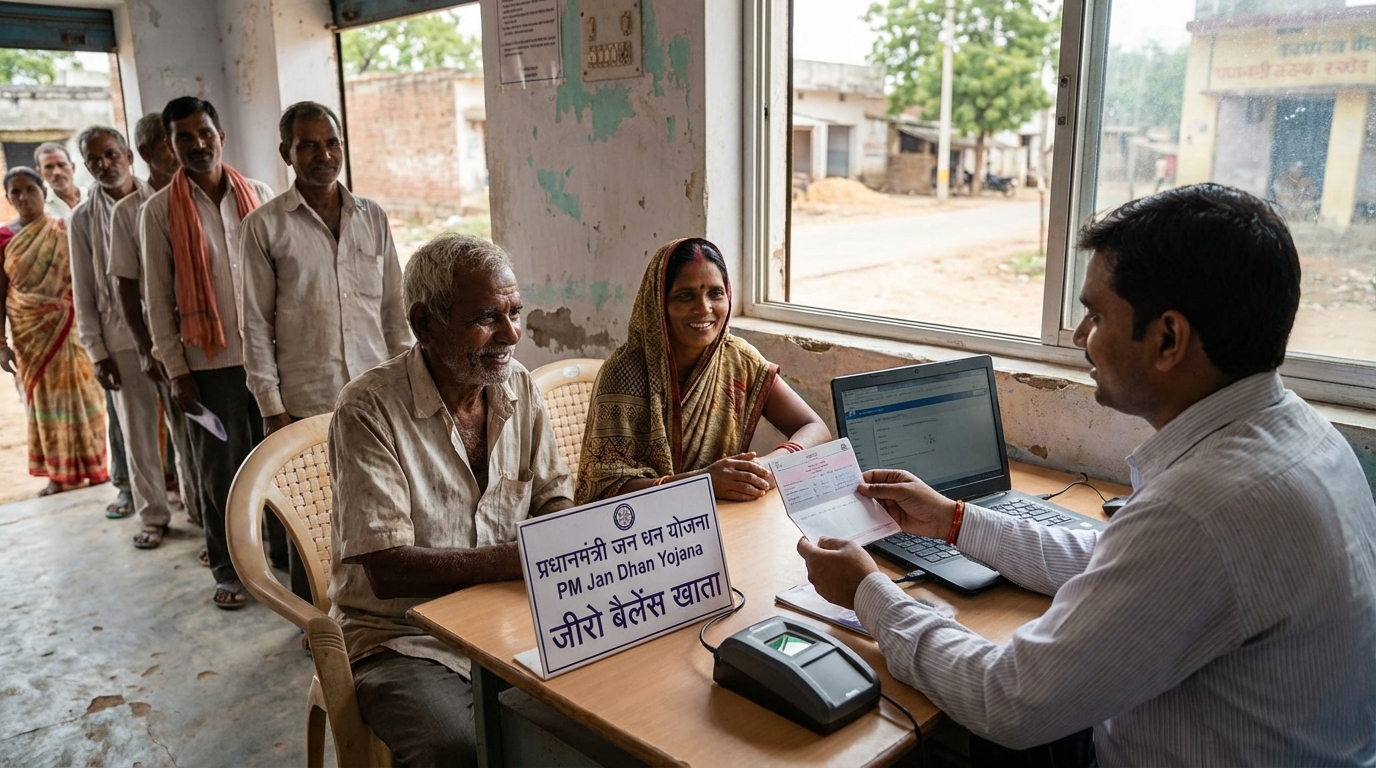
You can go to the nearest branch of any bank. All banks, whether they are government banks or private banks, can open a PM Jan Dhan Yojana account for you. You can also find a ‘Bank Mitra’ or a Business Correspondent in your area. They are people who help the bank provide services in places where there is no bank branch.
Step 2: Get the Account Opening Form
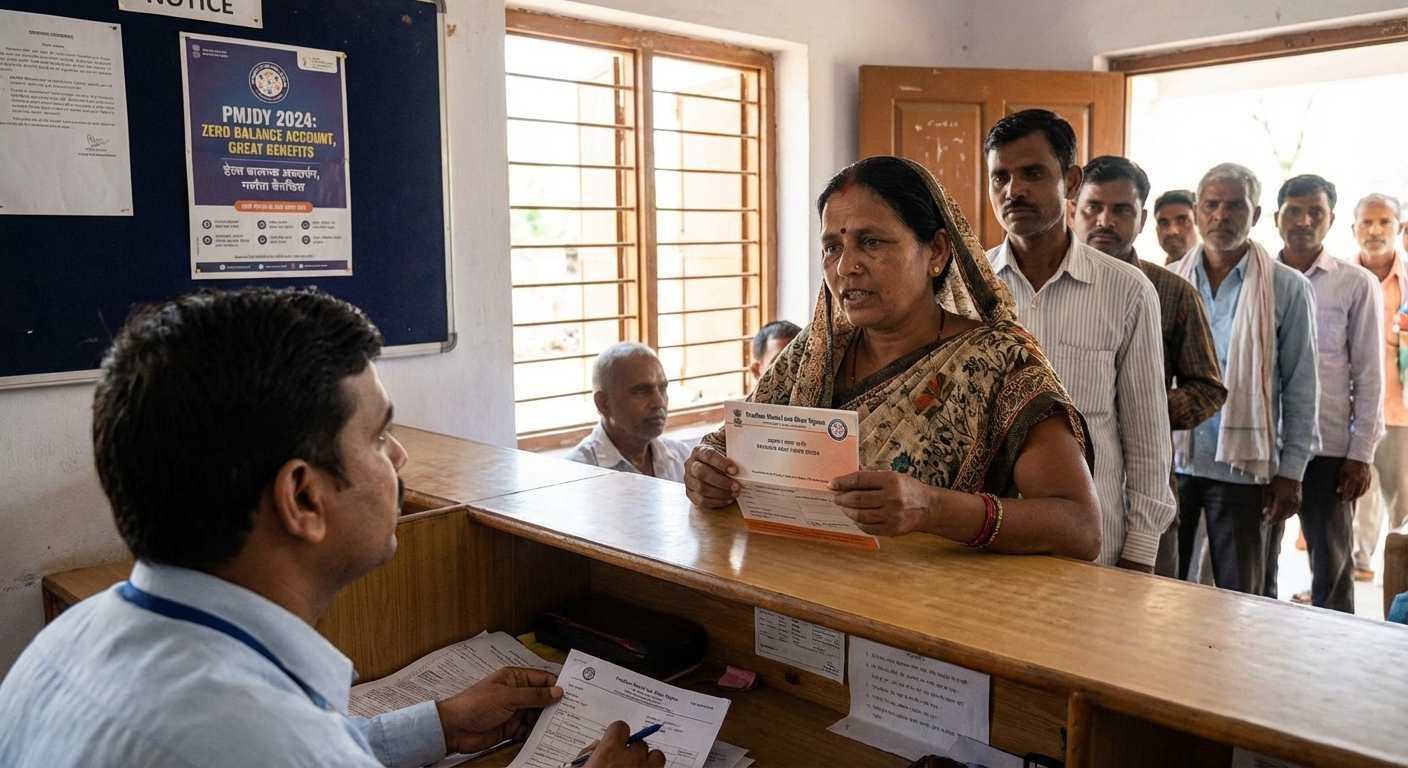
Ask the bank official or the Bank Mitra for a PM Jan Dhan Yojana account opening form. This form is usually very simple and is available in both Hindi and English. You can also download this form from the bank’s website.
Step 3: Fill the Form Correctly
Fill out the form with your basic details like your name, address, phone number, and other information. If you need help, you can ask the bank staff or the Bank Mitra to assist you. They are there to help you.
Step 4: Attach Your Documents
Attach a copy of your identity and address proof documents with the form. As we mentioned, if you have an Aadhaar card, that is all you need. Don’t forget to carry your original documents with you for verification.
Step 5: Submit the Form
Once you have filled the form and attached the documents, submit it to the bank official. They will check your details, and your account will be opened. You will receive your passbook and RuPay debit card soon after.
Simple Steps to Apply
| Step Number | Action to be Taken |
|---|---|
| 1 | Visit the nearest bank branch or a Bank Mitra outlet. |
| 2 | Get the PMJDY account opening form. |
| 3 | Fill in all your details in the form. |
| 4 | Attach copies of the required documents (like Aadhaar card). |
| 5 | Submit the form to the bank. Your account is ready! |
READ MORE: Rashtriya Fiber Yojana 2026
Conclusion
The PM Jan Dhan Yojana is more than just a scheme; it’s a doorway to a secure financial future for millions of Indians. It empowers people by giving them access to banking, credit, and insurance. Having a bank account helps you save money safely, receive government benefits directly without any middlemen, and plan for your future. The best part is the zero-balance facility, which removes the biggest fear from people’s minds. If you or someone you know does not have a bank account, encourage them to open one under the PM Jan Dhan Yojana. It is a simple, safe, and powerful tool for a better life.
Frequently Asked Questions (FAQs)
1. Can a student open a PM Jan Dhan Yojana account?
Yes, absolutely. Any Indian citizen who is 10 years or older can open an account under the PM Jan Dhan Yojana, including students.
2. Is there any fee for opening the account or for the debit card?
No, there are no fees for opening a Jan Dhan account. The RuPay debit card provided with the account is also free, and there are no annual maintenance charges on it.
3. What if I already have a regular savings account?
The PM Jan Dhan Yojana is primarily for those who don’t have any account. However, if you have a Basic Savings Bank Deposit (BSBD) Account, you can ask your bank to convert it into a Jan Dhan account to get all the added benefits.
4. What exactly does ‘zero balance’ mean?
‘Zero balance’ means you are not required to maintain any specific minimum amount of money in your account. Your account will remain active even if the balance is zero, and the bank will not charge you any penalty for it.
5. How do I keep my free insurance active?
To keep your free accident insurance cover active, you must use your RuPay debit card for at least one successful transaction (at an ATM or a shop) once every 90 days.
6. Do I earn interest on the money in my Jan Dhan account?
Yes, just like a regular savings account, you will earn interest on the money you deposit in your PM Jan Dhan Yojana account. The interest rate is the same as the bank’s normal savings account interest rate.
7. Who is a Bank Mitra?
A Bank Mitra is an agent of the bank who provides basic banking services in remote areas and villages where there are no bank branches. They can help you open your Jan Dhan account and do small transactions.
Important Links
| Link Title | URL |
|---|---|
| Official PMJDY Website | Click Here |
| Scheme Details (in English) | Click Here |
| Account Opening Form (English) | Click Here |
| Account Opening Form (Hindi) | Click Here |